

Orchestrate events
Mapping Our Roles and Reimagining Our Relationships: Orchestrating a Local Circular Textile/Fashion Ecosystem in Greater Manchester
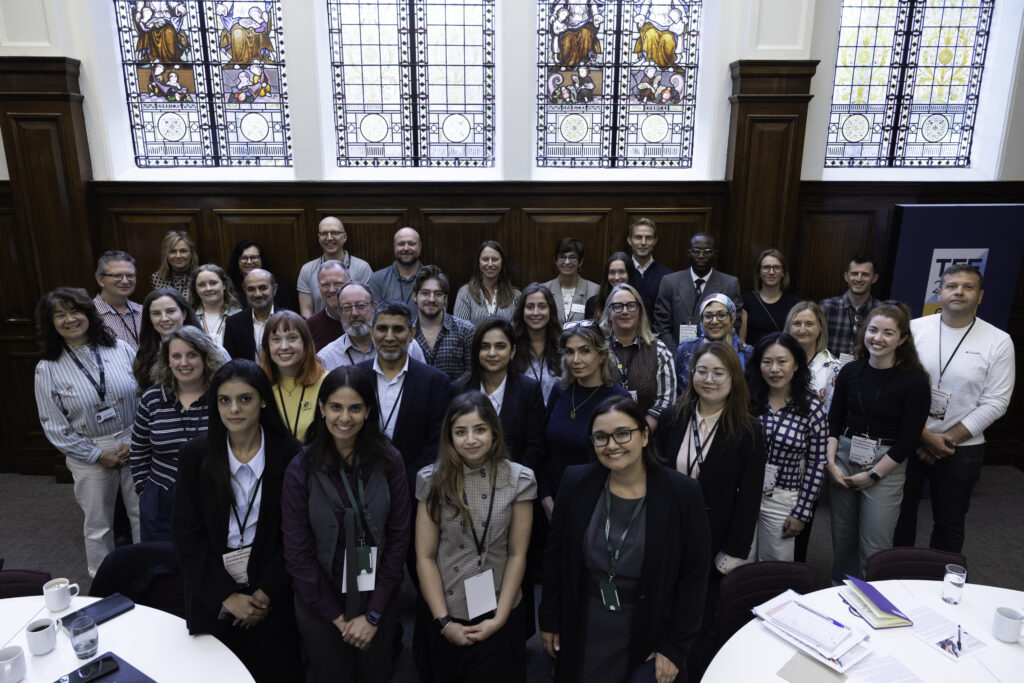
In September 2025, the Orchestrate community co-organised a half-day workshop at Manchester Metropolitan University with Future Fashion Fair, bringing together 30–40 stakeholders from across Greater Manchester’s circular fashion and textile ecosystem. The session explored how a more connected and place-based circular system could emerge, focusing on collaboration, shared challenges, and opportunities for change. Participants mapped existing roles and relationships, reflected on barriers to circularity, and contributed ideas to inform future tools, policy, and partnerships.
The session was structured around three interactive activities:
- First, participants mapped the current ecosystem by identifying their roles, key relationships, and the material, knowledge, and value flows connecting them.
- Second, they examined barriers, gaps, and enablers shaping circularity in Greater Manchester.
- Third, they worked in groups to prototype possible futures for a more connected and place-based circular textile and fashion ecosystem, including quick wins and longer-term systemic changes.
Aims :
The central aim of the workshop was not simply to generate discussion, but to support the emergence of a stronger Manchester-based circular fashion community.
Organising Committee
- Tulin Dzhengiz, Niamh Cusack, Alaa Abed – The Orchestrate community.
- Joseph Mountain and Niamh Donavan – Future Fashion Fair
Explore the event materials
To make the workshop conversations available beyond the sesison on 25th Sept. we are sharing the below helpful resources:
Panel Discussion: Orchestrating Circular Ecosystems: A Symphony or a Cacophony
On 3 March 2026, the Orchestrate community hosted a 90-minute online panel discussion in collaboration with the British Academy of Management and BAM SIGs. The event brought together academics and practitioners to explore how circular ecosystems are understood and coordinated across different sectors and regions. Discussions focused on whether these systems operate in harmony or are shaped by challenges such as fragmented coordination and differing expectations, and how they can be better aligned to support circular transitions.
Audiences:
- Academics
- Practitioners
- Policymakers
- Sustainability leaders
- Anyone interested in circular ecosystems
Academic panellists
- Theme 1: Paavo Ritala, Professor of Strategy and Innovation, LUT Business School, Finland
- Theme 2: Gary Walpole, Co-Director of the Regional Innovation and Regeneration Centre, Cardiff School of Management, Cardiff Metropolitan University, United Kingdom
- Theme 3: Lina Dagiliene, Full Professor and Leader of the Circular Economy Research Group, School of Economics and Business, Kaunas University of Technology (KTU), Lithuania
Practitioner panellists
- Theme 1: Sari Kola, Director, EnergySampo Ecosystem
- Theme 2: Declan Lee-Merrion, Sustainability Manager, Bluestone, British National Park Resort/Hospitality
- Theme 3: Laurynas Virbickas, the Director of the Kaunas Regional Waste Management Centre in Lithuania
What the panel explored
The session was organised around three themes, each pairing an academic and practitioner perspective:
1
Conceptual foundations of CE ecosystems and orchestration metaphors
This discussion explored whether “ecosystem” is the right metaphor for circular economy transitions and why “orchestration” has become such a prominent way of describing the coordination of circular ecosystems.
2
Practising and performing circular ecosystems
This theme focused on what successful circular ecosystems look like in practice, what makes them effective or ineffective, and what it means to enact and sustain them in real organisational settings.
3
Roles, responsibilities, and place embeddedness in circular ecosystems
The final theme examined how stakeholder roles and responsibilities shift across contexts, how place shapes ecosystem development, and how local, national, and global circular ecosystems interact.
Organising committee
This event was organised by the Orchestrate project (BAM/SAMS funded) and colleagues from the British Academy of Management special interest groups.
Organising committee
- Alaa Abed and Tulin Dzhengiz – Orchestrate project
- Patricia Prado – BAM, Innovation SIG
- Dongmei Cao, Simon Smith, and Polina Baranova – BAM, Sustainable and Responsible Business (SRB) SIG
- Pooja Gupta – BAM, Entrepreneurship SIG
Explore the event materials
To make the discussion available beyond the live session, we are also sharing the materials from the event here on the website.
Orchestrate Final Conference
The ORCHESTRATE Final Conference, “From Vicious Cycles to Virtuous Levers”, held at Manchester Metropolitan University on 16 September 2026, aimed to share the project’s findings, examine the interconnected barriers to circular fashion and textiles, and bring researchers, businesses, policymakers and community organisations together to develop practical responses and future collaborations. More than 35 participants attended in person, with a further 20–25 joining online during the morning hybrid session. Presentations were delivered by Tulin Dzhengiz, Alaa Abed, Nicolas Prophte, Jane Turnbull, Adam Gardiner, Aiman Aziz, Alan Wheeler, Ghada Soliman, David Tyson, Lily Melody and Jonathan Abra, while the afternoon roundtables were facilitated by Tulin Dzhengiz, Alaa Abed, Songyi Yan, Professor Sally Randles, Barbara Shepherd, Hilde Heim and Professor Matt Allen. Through research presentations, practitioner examples and collaborative discussions, the event enabled participants to test emerging findings, exchange knowledge across sectors and develop six initial collaboration propositions covering charity retail resilience; finance, ESG and circular transition; microplastics and circularity; Manchester’s circular textile future; digital product passports and farm-to-fibre traceability; and just circular transitions. It also identified connections between traceability and credible investment evidence, opened opportunities for collaboration between universities, industry and communities, and laid the groundwork for future research, innovation and funding proposals linking textile waste reduction with business viability, skills, wellbeing and social inclusion.